

- Understanding the Power of AI in Marketing Reporting
- How AI Enhances Data Analysis
- The Predictive Capabilities of AI
- Key Benefits of AI Marketing Reporting
- Improved Customer Behavior Prediction
- Enhanced Analysis of Customer Engagements
- More Effective Targeted Advertising
- Automation of Marketing Processes
- Fostering Better Customer Relationships
- Optimization of Marketing Content
- AI-Powered Tools for Marketing Reporting
- Metrics Watch
- Albert
- Persado
- Adext AI
- Revealbot
- Cortex by Adverity
- Implementing AI in Your Marketing Strategy
- Start with Clear Objectives
- Choose the Right Tools
- Track and Measure Results
- Stay Updated on AI Trends
- The Future of AI in Marketing Reporting
- Enhanced Personalization
- Improved Automation
- More Accurate Predictions
- Conclusion
The world of digital marketing is constantly evolving, and AI marketing reporting is becoming an indispensable tool for businesses looking to stay ahead. Artificial intelligence offers unprecedented capabilities for analyzing data, predicting trends, and optimizing marketing strategies. This article will explore how AI is transforming marketing reporting, providing valuable insights into its benefits and practical applications. We will delve into how AI-powered tools can enhance your understanding of customer behavior, improve campaign performance, and ultimately drive better results.
n
Understanding the Power of AI in Marketing Reporting
n
Artificial intelligence (AI) is revolutionizing how marketers approach data analysis and reporting. Unlike traditional methods that rely on manual data collection and interpretation, AI leverages machine learning to automate these processes, providing real-time insights and predictive analytics. This shift allows marketers to move beyond simply tracking past performance and instead focus on optimizing future strategies. AI marketing reporting is not just about generating reports; it's about extracting actionable intelligence that can drive significant business growth.
n
How AI Enhances Data Analysis
n
One of the primary benefits of AI is its ability to process vast amounts of data quickly and accurately. AI algorithms can analyze customer interactions across multiple platforms, including websites, social media, and email. This comprehensive view of customer behavior allows marketers to identify patterns, predict trends, and personalize their approach. By automating the data analysis process, AI enables marketers to focus on strategic decision-making, rather than getting bogged down in manual tasks. This leads to more efficient and effective marketing campaigns.
n
The Predictive Capabilities of AI
n
Beyond analyzing historical data, AI also provides powerful predictive capabilities. Machine learning models can forecast the outcomes of various marketing strategies, allowing marketers to proactively adjust their campaigns for maximum impact. For instance, AI can predict which customer segments are most likely to respond to a particular offer, enabling more targeted advertising. This predictive approach reduces wasted resources and improves the overall return on investment (ROI). AI marketing reporting empowers marketers to make data-driven decisions, rather than relying on intuition alone.
n
Key Benefits of AI Marketing Reporting
n
Integrating AI into your marketing reporting processes offers numerous advantages. These benefits span from improved customer engagement to increased efficiency and more accurate predictions. Here are some key ways that AI marketing reporting can transform your approach:
n
Improved Customer Behavior Prediction
n
One of the most significant benefits of AI is its ability to predict customer behavior. By analyzing historical data and identifying patterns, AI systems can determine which prospects are most likely to respond to your offers. This capability allows marketers to target their efforts more effectively, saving time and resources. This level of insight is invaluable for optimizing advertising spend, ensuring that resources are allocated to the most promising leads.
n
Enhanced Analysis of Customer Engagements
n
Measuring customer engagement is crucial for determining the success of marketing campaigns. AI tools can track engagement across various platforms, providing valuable insights into what works and what doesn't. By comparing old and new client data, marketers can learn how to produce more regular customers. AI also provides information about what each client wants and how to target them effectively. This level of analysis allows for more personalized and impactful marketing strategies.
n
More Effective Targeted Advertising
n
Traditional advertising methods often involve broad targeting, which can be inefficient and costly. AI enables marketers to target specific audiences based on their preferences and behaviors. By combining AI with predictive consumer segmentation, marketers can create personalized customer experiences that resonate with their target audience. This level of precision leads to increased conversion rates and a more efficient use of advertising budgets.
n
Automation of Marketing Processes
n
AI can automate many repetitive marketing tasks, freeing up marketers to focus on more strategic activities. Through AI systems, businesses can automate pay-per-click (PPC) ads, search engine marketing (SEM), SEO, conversion rates, social media marketing (SMM), and keyword research. This automation not only saves time but also ensures consistency and accuracy in marketing efforts.
n
Fostering Better Customer Relationships
n
AI plays a critical role in customer relationship management. By providing real-time insights into customer interactions across various communication platforms, AI helps businesses understand their customers better. AI can automatically assign customer concerns to the appropriate support group and use statistical models to determine the optimal next step. Additionally, chatbots powered by AI can provide immediate customer support, enhancing customer satisfaction.
n
Optimization of Marketing Content
n
AI helps marketers optimize their content by identifying topics that are likely to attract their audience’s attention. By analyzing data on user preferences and behavior, AI systems can determine what content resonates most effectively. This allows marketers to create content that is not only engaging but also aligned with their audience’s needs and interests, ultimately improving marketing campaign performance.
n
AI-Powered Tools for Marketing Reporting
n
Several AI-based tools are available to enhance your AI marketing reporting capabilities. These platforms offer a range of features, including data analysis, predictive analytics, and automation. Here are some notable examples:
n
Metrics Watch
n
Metrics Watch provides automated reporting tools that pull data from various marketing channels, including Google Analytics, Google Search Console, Google Ads, Facebook, Instagram, and Mailchimp. This platform allows marketers to create email-based reports with a simple drag-and-drop editor. Reports are delivered directly to recipients' inboxes, eliminating the need for them to log into third-party dashboards. Graphs and charts help visualize data, making reports easy to read and more actionable.
n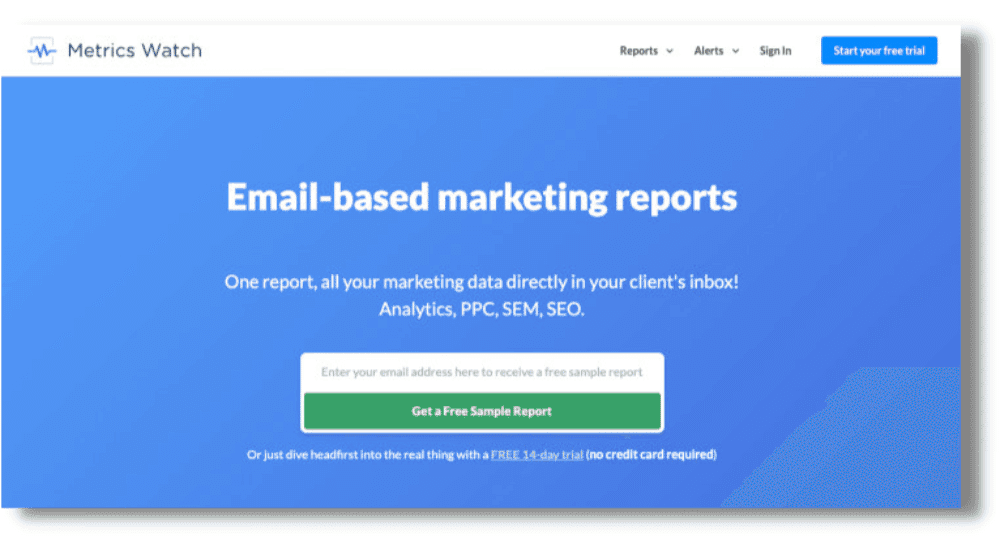 n
Credit: https://aimarketingmonster.com
nn
Albert
n
Albert is an AI-powered digital marketing platform that automates and optimizes marketing campaigns across multiple channels. It uses machine learning to analyze data, target audiences, and optimize ad performance in real-time. Albert provides marketers with the ability to improve campaign performance and reduce the time spent on manual tasks.
n
Persado
n
Persado is an AI platform that generates and optimizes marketing messages using Natural Language Processing (NLP) and Machine Learning (ML). It helps marketers create persuasive and personalized content for various channels, enhancing engagement and conversion rates.
n
Adext AI
n
Adext AI is an AI-driven digital advertising platform that uses machine learning to optimize ad campaigns across multiple platforms and channels. It automatically adjusts ad budgets and targeting to maximize performance, ensuring that resources are allocated effectively.
n
Revealbot
n
Revealbot is an AI-powered automation platform for digital advertising campaigns. It enables marketers to automate ad creation, optimization, and reporting across platforms like Facebook, Instagram, and Google Ads, saving time and improving efficiency.
n
Cortex by Adverity
n
Cortex is an AI-powered marketing analytics platform that consolidates and analyzes data from various sources to provide insights and recommendations. It helps marketers optimize their campaigns and make data-driven decisions based on comprehensive data analysis.
n
Implementing AI in Your Marketing Strategy
n
To effectively leverage AI marketing reporting, it's crucial to track results and measure the impact on your business. Here are some tips for incorporating AI into your marketing strategy:
n
Start with Clear Objectives
n
Before implementing AI, define your marketing objectives. What specific goals do you want to achieve? Whether it's increased conversion rates, website traffic, or lead generation, having clear objectives will help you choose the right AI tools and strategies.
n
Choose the Right Tools
n
Select AI-powered tools that align with your specific needs and budget. Consider the features and capabilities of each tool and how they can help you achieve your marketing objectives. It's also essential to ensure that the tools are compatible with your existing marketing stack.
n
Track and Measure Results
n
Regularly monitor the performance of your AI-driven marketing campaigns. Use automated reporting tools to track key metrics and identify areas for improvement. This data-driven approach allows you to optimize your strategies and allocate resources more effectively.
n
Stay Updated on AI Trends
n
AI is a rapidly evolving field, so it's important to stay updated on the latest trends and technologies. Continuously learn about new AI tools and techniques to ensure that your marketing strategy remains effective and competitive.
n
The Future of AI in Marketing Reporting
n
The future of AI marketing reporting is bright, with ongoing advancements in AI technology promising even more powerful capabilities for marketers. As AI continues to evolve, we can expect to see more sophisticated tools that provide deeper insights and more precise predictions. AI will become an even more integral part of the marketing process, empowering businesses to make data-driven decisions and achieve better results.
n
Enhanced Personalization
n
AI will further enhance personalization capabilities, enabling marketers to deliver highly tailored experiences to individual customers. By analyzing data on a granular level, AI will be able to understand individual customer preferences and behaviors, allowing for more targeted and effective marketing campaigns.
n
Improved Automation
n
AI will continue to automate marketing processes, reducing the need for manual tasks and freeing up marketers to focus on strategic initiatives. This will lead to greater efficiency and productivity, allowing businesses to scale their marketing efforts more effectively.
n
More Accurate Predictions
n
AI-powered predictive analytics will become even more accurate, allowing marketers to make more informed decisions about their marketing strategies. This will lead to better resource allocation, improved campaign performance, and higher ROI.
n
Conclusion
n
AI marketing reporting is transforming the way businesses approach digital marketing. By automating data analysis, providing predictive insights, and enhancing personalization, AI empowers marketers to make more informed decisions and achieve better results. As AI technology continues to evolve, it will become an even more critical component of successful marketing strategies. By embracing AI, businesses can stay ahead of the competition and unlock new opportunities for growth. The integration of AI in marketing reporting is not just a trend; it's a fundamental shift that is reshaping the industry.





