

- Understanding the Impact of AI on Marketing
- The Rise of Dynamic Content Creation
- AI’s Strategic Role in Marketing
- Key Trends in AI Marketing Integration
- The Evolution of Search
- Video Marketing with AI
- The Rise of Virtual Influencers
- Prioritizing Privacy
- Practical Examples of AI in Marketing
- Personalization and Targeted Messaging
- Content Creation and Optimization
- Advertising and A/B Testing
- Email Marketing Optimization
- Enhanced Customer Experience
- Other Notable Examples
- Implementing AI in Your Marketing Strategy
- Types of AI in Marketing
- Key Steps for AI Integration
- How to Use AI for Segmentation and Targeting
- How to Improve Orchestration with AI
- How AI Can Advance Personalization
- How AI Unlocks Richer Insights
- Best Practices for Implementing AI Strategies
- The Future of AI in Marketing
Artificial intelligence (AI) is rapidly transforming the marketing landscape, making AI marketing integration a critical strategy for businesses looking to stay competitive. This article explores the key trends, strategies, and practical examples of how AI is being integrated into marketing to drive better results, enhance customer experiences, and streamline operations. We'll look at how AI is changing content creation, strategic decision-making, search engine optimization, and much more.
n
Understanding the Impact of AI on Marketing
n
The integration of AI in marketing isn't just about adopting new technologies; it's about fundamentally changing how businesses connect with their customers. AI is moving beyond basic data analysis and recommendation systems to become a crucial strategic partner in marketing. From predicting market trends to optimizing resource allocation in real-time, AI is revolutionizing marketing practices.
n
The Rise of Dynamic Content Creation
n
One of the most significant shifts is the move towards dynamic content creation. Generative AI is enabling the creation of content that adapts in real-time to context and audience sentiment. This goes far beyond basic AI-generated blog posts. Forward-thinking creators are integrating AI into their creative processes, showing audiences how to use it in novel ways. In 2025, we will see content that transforms based on viewer behavior, time of day, and even global events, taking marketing "micro-moments" to a new level.
n
AI's Strategic Role in Marketing
n
AI is also taking on a more strategic role in marketing. It's no longer just a tool for tactical operations; it's becoming a partner in high-level planning and decision-making. AI systems can now predict future market trends, simulate campaign outcomes, and optimize resource allocation. This strategic evolution is happening first in marketing, setting patterns that other business functions will likely follow.
n
Key Trends in AI Marketing Integration
n
Several key trends are shaping the future of AI marketing integration. These trends are not only changing how marketing is done but also what it means to connect with customers effectively.
n
The Evolution of Search
n
The integration of generative AI into search engines is completely reimagining how people find information online. With AI-generated responses now directly embedded in search results, the traditional SEO playbook is being rewritten. Marketers must now grapple with ensuring their brand messages are captured and conveyed effectively through AI-generated responses. It's not just about keywords anymore; it's about understanding and influencing the AI systems that are becoming the new gatekeepers of information.
n
Video Marketing with AI
n
Video content continues to be a powerful marketing tool. AI-driven video production tools are making it possible to create personalized, targeted video content at scale. New formats like shoppable video and live streaming are opening up new avenues for brand engagement. User-generated content remains a key force, and AI is making the creation and sharing process more sophisticated. In 2025, the ability to create, optimize, and distribute video content will be more about strategic application than technical capability.
n
The Rise of Virtual Influencers
n
Virtual influencers are getting smarter, moving beyond static digital avatars to AI-powered personalities that can engage in real-time interactions with audiences. These influencers can embody brand values, be available 24/7, and engage with thousands of followers simultaneously in personalized conversations. This offers enormous potential for brands.
n
Prioritizing Privacy
n
The balance between personalization and privacy is becoming more critical. Smart marketers are adopting "privacy-first personalization," which delivers relevant experiences while maintaining transparent and ethical data practices. This is about building trust in an era where consumers are increasingly aware of their digital footprint.
n
Practical Examples of AI in Marketing
n
To illustrate the impact of AI marketing integration, let's look at some real-world examples. These examples showcase how various companies are leveraging AI to enhance different aspects of their marketing strategies.
n
Personalization and Targeted Messaging
n
- n
- Whole Foods: Uses AI to analyze shopping activity and provide hyper-personalized marketing. For example, if a customer regularly buys pasta, basil, and tinned tomatoes, the retailer could send them a promo code for other Italian-related ingredients.
- BuzzFeed: Uses AI to deliver personalized content at scale, enhancing the quiz experience and personalizing content for their audience.
n
n
n n
AI-generated results of BuzzFeed’s “Get a Fresh Start” quiz
Credit: https://blog.socialmediastrategiessummit.com
nn
Content Creation and Optimization
n
- n
- ClickUp: Uses natural language processing (NLP) AI tools to optimize content, identify keywords, and improve article structure, resulting in an 85% increase in organic traffic.
- Heinz: Launched an ad campaign with visuals generated entirely by AI, prompting consumers to share their own AI prompts for ketchup-based imagery.
n
n
n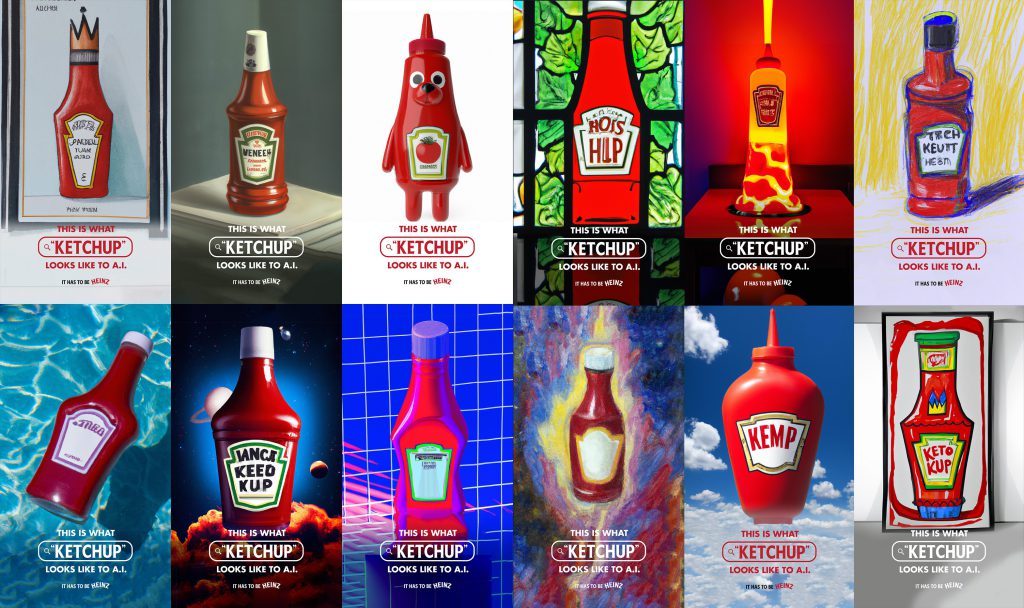 n
What does AI think ketchup looks like?
Credit: https://blog.socialmediastrategiessummit.com
nn
Advertising and A/B Testing
n
- n
- Euroflorist: Uses AI to drive A/B testing at scale, finding the perfect combination from thousands of variants and boosting website conversion rates by 4.3%.
- Interactive Investor: Uses AI to optimize PPC campaigns, resulting in a 286% increase in keywords and a significant drop in cost per acquisition.
n
n
n
Email Marketing Optimization
n
- n
- Imagine Business Development: Leveraged AI to personalize email delivery times, doubling open and click rates and increasing total email conversions by 100%.
- eBay: Uses AI to enhance marketing copy, focusing on email, resulting in a 16% average open uplift and 31% average click uplift.
n
n
n
Enhanced Customer Experience
n
- n
- Dept and Hello Monday: Created an AI-powered "Shoe Mirror" that analyzes what passersby are wearing, finds matching shoes, and allows users to purchase them through augmented reality.
- Magnolia Market: Uses augmented reality to allow users to view products in 3D and "place" them in their homes, bridging the online-to-offline experience.
n
n
n n
Creating interactive ads using AI technology
Credit: https://blog.socialmediastrategiessummit.com
nn
Other Notable Examples
n
- n
- Coca-Cola: Launched its own AI platform, "Create Real Magic," combining GPT-4 and DALL-E to allow fans to create digital artwork based on branded assets.
- Chase Bank: Uses AI-powered copywriting to achieve more humanity in its marketing.
- Starbucks: Uses predictive analytics to serve personalized recommendations to customers.
- Alibaba: Opened a "FashionAI" store with intelligent garment tags and smart mirrors to enhance the retail experience.
- Ben & Jerry’s: Identified the trend for "ice cream for breakfast" using AI data analysis.
- Amazon: Uses machine learning to offer personalized product recommendations.
- Sephora: Uses chatbots to dispense beauty advice.
- American Marketing Association (AMA): Uses AI to personalize newsletter subject lines, increasing engagement by 42%.
- Unilever: Uses generative AI for consumer engagement and support, reducing drafting time by over 90%.
- PepsiCo: Uses AI to regain market share for its Walkers chip brand.
- SimCorp: Scales product explainer video creation using AI, reducing production time significantly.
- Zoom: Uses AI to maintain brand consistency in its communications, saving over 7,000 hours.
- Bamboo Rose: Doubles content output with AI, speeding up the creation process.
- Gobi Cashmere: Leverages AI for personalized experiences, increasing conversions by 300-400%.
- Mercedes-Benz: Uses AI to monitor social media mentions and tailor its marketing campaigns.
- Tea Collection: Uses AI for A/B testing on landing pages, boosting order volumes.
n
n
n
n
n
n
n
n
n
n
n
n
n
n
n
n
n
Implementing AI in Your Marketing Strategy
n
Integrating AI into your marketing strategy requires a structured approach. Here's a roadmap to help you get started with AI marketing integration.
n
Types of AI in Marketing
n
Before diving in, it's essential to understand the different types of AI used in marketing:
n
- n
- AI (Artificial Intelligence): Simulates human intelligence by processing data with algorithms and pattern detection.
- ML (Machine Learning): Analyzes data to identify trends, make predictions, and automate decision-making.
- Predictive AI: Analyzes patterns and gets smarter the more you use it, great at predicting what and when someone might want to see, read, or buy.
- Generative AI: Automates creative tasks such as writing and image generation, prompted by everyday language (NLP).
n
n
n
n
n
Key Steps for AI Integration
n
- n
- Define Clear Goals: Set clear objectives for your AI initiatives. Whether you want to improve customer engagement, optimize ad targeting, or boost lead generation, having well-defined objectives will help you stay on track.
- Pilot Program: Start with a pilot program. Test AI in one area or campaign and monitor its impact closely.
- Choose the Right Tools: Select AI tools and platforms that align with your needs, budget, and technical skills.
- Integrate with Existing Systems: Connect your existing marketing systems and processes to your AI tools.
- Train Your Team: Provide training to your team on how to use AI effectively, interpret data, and stay updated with the latest developments.
n
n
n
n
n
n
How to Use AI for Segmentation and Targeting
n
AI enhances segmentation by quickly scoring leads and accurately segmenting audiences based on various criteria. Tools like Real-time segmentation and lookalike features can help identify groups to target and generate lookalike audiences based on existing insights. AI can also be used to target specific groups with messaging or ads as they browse your website.
n
How to Improve Orchestration with AI
n
AI can synchronize, automate, and optimize complex processes and workflows. This includes:
n
- n
- AI-powered chatbots
- Virtual assistants
- Send Time Optimization
- Machine learning to automate complex decisions
- SEO improvements
- A/B testing with predictive AI
- Generative AI for content creation
n
n
n
n
n
n
n
n
How AI Can Advance Personalization
n
AI can analyze vast amounts of data in real-time and personalize touchpoints on the go. Tools like Einstein Content Selection help optimize campaigns by evaluating which images generate the highest click-through rates. AI combined with dynamic content makes personalizing the browsing experience effortless.
n
How AI Unlocks Richer Insights
n
AI tools that connect with your system allow for better tracking, performance modeling, and more accurate predictions with analytics. Machine learning can analyze sales data to predict market demand and adjust pricing dynamically based on real-time data. Sentiment analysis can also enhance social listening tools.
n
Best Practices for Implementing AI Strategies
n
- n
- Set clear goals and objectives.
- Run a pilot program.
- Choose the right AI tools and platform.
- Connect your existing marketing systems to your AI tools.
- Train your marketing team on how to use AI effectively.
n
n
n
n
n
n
The Future of AI in Marketing
n
The future of AI marketing integration is bright, with AI set to play an even more significant role in shaping marketing strategies and customer experiences. As AI technologies continue to evolve, businesses that embrace and integrate them thoughtfully will be best positioned to thrive in the competitive marketing landscape. The key is not just adopting new technologies, but using them strategically to create genuine value for customers.
n
By understanding the trends, leveraging practical examples, and following a structured approach to implementation, businesses can harness the power of AI to elevate their marketing strategies and achieve greater success. The journey of AI marketing integration is ongoing, and those who adapt and innovate will undoubtedly lead the way.





